UNLOCODE Lookup (UN/LOCODE Port and Location Codes)
Search a place name or a code like NLRTM to see the UN/LOCODE, what the location is used for and where it is.
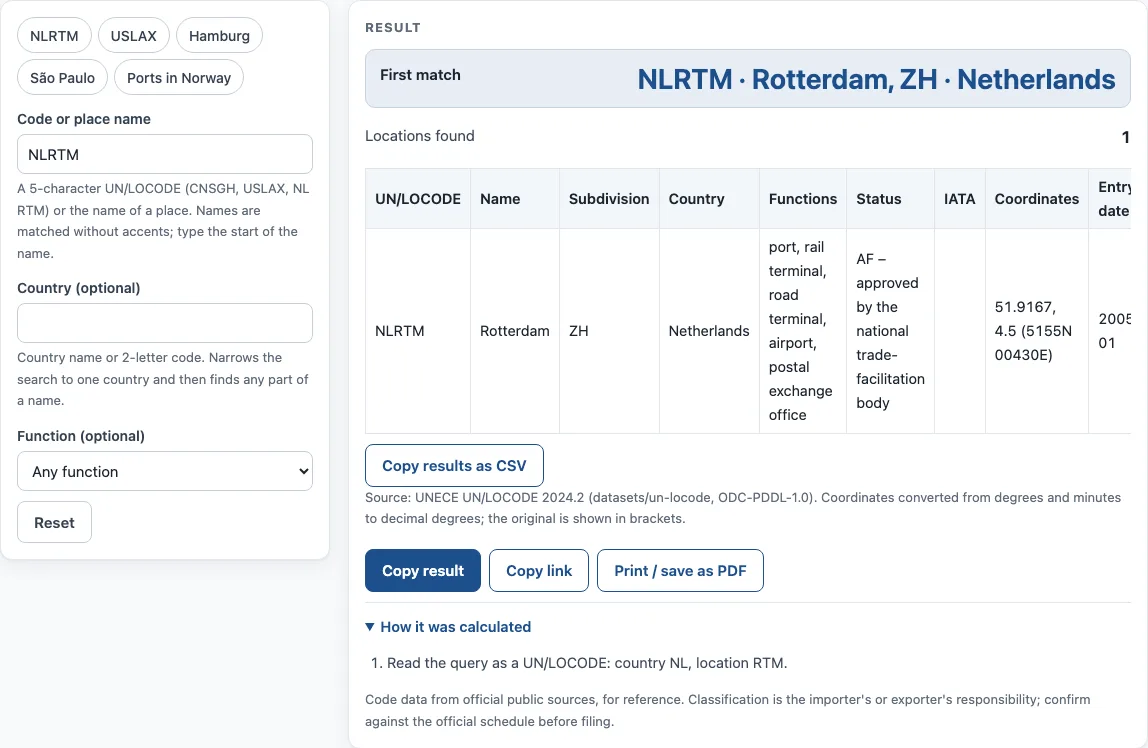
How to use the UNLOCODE Lookup
- In the Code or place name field, type a 5-character code such as USLAX, or type a place name. Names match without accents, so type the start of the name.
- Optional: in the Country (optional) field, enter a country name or a 2-letter code, such as NL. This limits the search to one country and then finds any part of a name.
- Optional: in the Function (optional) list, choose a type of location: 1 Port, 2 Rail terminal, 3 Road terminal, 4 Airport, 5 Postal exchange, 6 Multimodal, 7 Fixed transport, or B Border crossing.
- Read the Locations found line for the number of matches, and the First match line for the top result. Check that it is the location you need.
- Read the table: code, name, subdivision, country, functions, status, IATA code when it differs, coordinates and the entry date.
- Open How it was calculated to see each step with your own values.
If you are not sure where to start, use the example buttons: NLRTM, USLAX, Hamburg, São Paulo, or Ports in Norway. Under the result, Copy result copies the answer, and Copy link copies a page address that keeps all your inputs, so opening it shows the same result again. Print / save as PDF prints your inputs, the result, the calculation steps and the date.
What is a UNLOCODE and how is it built?
A UNLOCODE, written in full as UN/LOCODE (United Nations Code for Trade and Transport Locations), is a short code that identifies a place used in trade and transport. The United Nations Economic Commission for Europe (UNECE) maintains the list. Each code has five characters: the first two are the ISO 3166 country code, and the last three are a location code given to that place within the country. For example, DEHAM is Hamburg, where DE is Germany and HAM is the location code.
Because the codes are short and fixed, they are used in bills of lading, booking systems, EDI messages and customs declarations to name ports of loading and discharge. A standard code avoids spelling differences between documents. Coordinates in the list are written as degrees and minutes. For example, 5155N 00430E means 51°55’N 4°30’E. The tool also shows decimal degrees.
What do the function and status codes mean?
The function code tells you what a location is used for. A place can have more than one function. The codes are 1 for port, 2 for rail terminal, 3 for road terminal, 4 for airport, 5 for postal exchange office, 6 for multimodal functions such as inland clearance depots, 7 for fixed transport such as pipelines and power lines, and B for border crossing. Use the Function filter to find only the type of place you need.
The status code shows how an entry was approved. AA means approved by a competent national government agency. AF means approved by a national facilitation body. AI means the code was adopted by an international organisation, such as IATA or ECLAC. RL means the place is a recognised location that exists in an official classification. RQ means the code has been requested and is under consideration. XX means the entry will be removed in the next issue. Check the status before you rely on a code in a formal document.
Sources
- UNECE UN/LOCODE — edition 2024-2, via the public-domain datasets/un-locode package (ODC-PDDL-1.0).
- UN/LOCODE code list column descriptions — function and status codes.
Frequently asked questions
Is UNLOCODE the same as UN/LOCODE?
Yes. Both names refer to the United Nations Code for Trade and Transport Locations. The slash form, UN/LOCODE, is the official name.
Can I use the results in commercial work?
Yes. You can use results on products, packaging and documents without attribution.
Does the tool send what I type to a server?
No. Everything runs in your browser, and nothing you type is uploaded.
Is the location code always the IATA airport code?
No. The location code is often the IATA airport code, but not always, so check the UN/LOCODE entry itself.
Why does CNSHA show an airport, not the port of Shanghai?
In this edition, CNSHA is listed as Shanghai Hongqiao International Airport. The port of Shanghai is CNSHG (Shanghai Port), and CNSGH covers Shanghai with port, rail, road, airport and postal functions. Many carriers still use CNSHA for the port in schedules, so check which code your carrier uses before you fill in a document.
What does a status of RQ mean?
RQ means the code has been requested and is still under consideration. It is listed, but it has not yet been approved in the way a code with an AA or AF status has.
Related tools
- ISO country codes — 2-letter, 3-letter and numeric country codes for documents and data.
- Container check digit calculator — check the ISO 6346 check digit of a shipping container number.
- HTS code lookup — find the US import classification number and its duty rates.
- HS tariff code lookup — find the international 6-digit HS code for a commercial invoice.
- Schedule B lookup — find the 10-digit US export code for an AES filing.
- GS1 barcode generator — GS1-128 labels with Application Identifiers, EAN-13 and ITF-14 carton codes.