Schedule B Lookup (US Export Codes)
Search by product words or number to find the 10-digit Schedule B code to report on US export filings.
Schedule B lookup finds the 10-digit Schedule B code used to report US exports, either by product words or by a code you already have. This tool searches the 2026 Schedule B export code list from census.gov. It runs in your browser, is free, and needs no sign-up. Nothing you type is uploaded.
Use it when you need to know which Schedule B number fits a product before you report a shipment. You can also use it to check a number you were given, or to browse all the lines in one chapter. A Schedule B number lookup works the same way, whether you start from a product name or from digits.
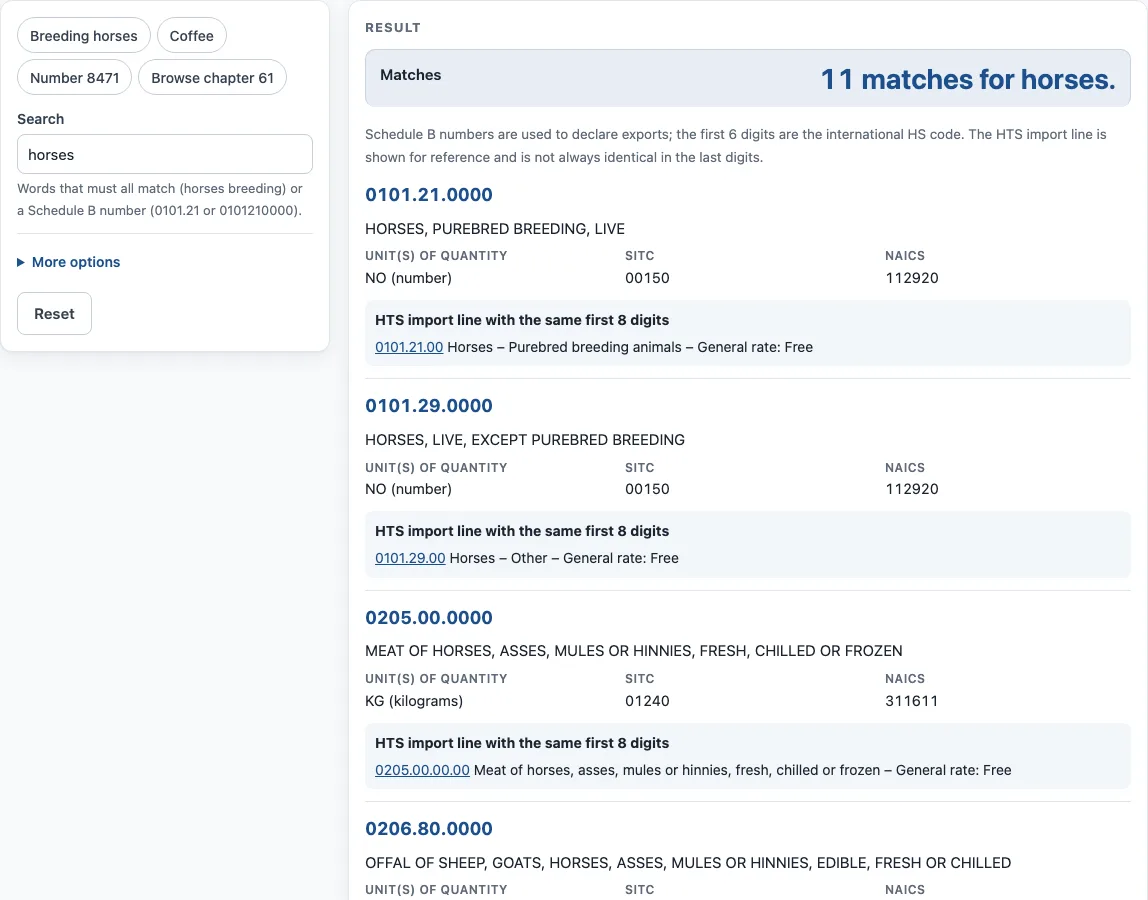
How to use the Schedule B lookup
- Type what you are looking for in the Search field. Use words that must all match, such as “horses breeding”, or a code such as 0101.21 or 0101210000.
- Open Search as and choose a mode. Automatic treats digits, dots and spaces as a code and anything else as words. Choose Words or Code prefix if you want to force one type of search.
- If you know the chapter, enter two digits from 01 to 99 in Chapter (optional). To browse a whole chapter, leave the Search field empty.
- Read the Matches line and the rows below it. Each row gives the code in its formatted form, its description, the unit or units of quantity to report, and the matching US HTS import line for reference (same first 8 digits, or the same first 6 when there is no 8-digit match).
- Select How it was calculated to see each step using your own values.
Four example buttons fill the fields automatically: Breeding horses, Coffee, Number 8471 and Browse chapter 61. Under the result, Copy result copies the answer, and Copy link copies a page address that keeps all your inputs, so opening it shows the same result. Print / save as PDF prints the inputs, the result, the calculation steps and the date.
What is a Schedule B number?
A Schedule B number is a 10-digit code that US exporters use to report what they ship out of the country. The US Census Bureau maintains the Schedule B. The first 6 digits are the international HS code, and digits 7 to 10 add US export detail. Numbers are written in groups, such as 0101.21.0000.
Since the first 6 digits follow the international HS system, the code also reveals the product family along with the US detail. Each line carries units of quantity to report, such as NO (number), KG (kilograms) or DOZ (dozens). Some lines need two units. Use the unit that the line lists, or the shipment report will not match the code.
When do you need a Schedule B number for an export?
US exporters must report a Schedule B number, or an HTS number, in the Automated Export System (AES) through ACE. Under the Foreign Trade Regulations (15 CFR part 30, checked October 2026), filing is required when the value under one code to one consignee is over US$2,500 (15 CFR 30.37(a)), and for any shipment that needs an export licence, whatever its value (15 CFR 30.2). Most shipments to Canada are exempt (15 CFR 30.36).
For most lines, the 10-digit HTS import number works in place of the code. A few lines do not allow this swap. The tool shows the matching HTS import line for reference, so you can compare the two.
How do I find the right Schedule B number?
Begin with the plain name and material of the product, such as “cotton t-shirts” or “stainless steel bolts”, or the HS code you already use on your commercial invoice. Read the full description of each candidate line, including the words “other” lines cover, and check the unit of quantity, since it shows how the line is meant to be counted. If two lines seem to fit, compare the chapter and heading wording and ask the Census Bureau’s classification help.
Codes like these do not set duties abroad. The importing country applies its own tariff, based on the first 6 HS digits. Classification is the exporter’s responsibility, but Census offers free help with it.
Sources
- U.S. Census Bureau Schedule B: 2026 export code file, downloaded 11 October 2026, public domain.
- Foreign Trade Regulations, 15 CFR 30.2 and 15 CFR 30.37 — when EEI must be filed in AES (checked October 2026).
Frequently asked questions
Is the Schedule B lookup free?
Yes. The tool is free and needs no sign-up.
Is anything I type sent to a server?
No. The tool runs in your browser, and nothing you type is uploaded.
What is the difference between a Schedule B number and an HTS number?
A Schedule B number is used to report exports. The HTS number is the 10-digit import number, and it can be used in place of the Schedule B number for most lines.
Can I use the results on products or packaging?
Yes. Results may be used in commercial work, including on products, packaging and documents, with no attribution needed.
Do Schedule B numbers decide the duty in another country?
No. The importing country applies its own tariff, based on the first 6 HS digits.
How often does the Schedule B change?
The Census Bureau publishes the Schedule B by edition year and updates it when HS or US statistical changes take effect. This tool uses the 2026 edition (census.gov, downloaded 2026-10-11), so check that an older number still exists before you reuse it.
Who is responsible for choosing the correct number?
The exporter is. Census offers free help with classification if you are unsure which line fits your product.
Related tools
- HTS code lookup: locates the US import classification number and its duty rates.
- HS tariff code lookup: looks up the international 6-digit HS code for a commercial invoice.
- ISO country codes: 2-letter, 3-letter and numeric country codes for documents and data.
- UNLOCODE lookup: helps you find the code of a port, airport or terminal for a booking or bill of lading.
- Container check digit calculator: verifies the ISO 6346 check digit of a shipping container number.
- UPC barcode generator: produces UPC-A and UPC-E barcodes for retail products, with add-ons and GS1 sizes.