HTS Code Lookup (US Harmonized Tariff Schedule)
Search by product words or the first digits of a code to find the US HTS number, its full description and the duty rates.
The HTS code lookup on this page searches the Harmonized Tariff Schedule of the United States (HTSUS, or HTS) and shows the tariff classification number and duty rates for a product. Type a product name, such as cotton t-shirts, or a code, such as 6109 or 0101.21.00, and the tool lists the matching lines.
The HTS covers every product that can be imported into the US. It is published by the US International Trade Commission (USITC), and the data here is the USITC export downloaded on 2026-10-11. This tool runs in your browser. It is free, and you do not need to sign up. Use it as a harmonized tariff code search before you check duty rates or prepare import paperwork.
How to use the HTS Code Lookup
- Type a product name or a code in the Search box. Plain words work best, such as “stainless steel bolts”, or digits, such as 6109.
- Open Search as and choose a mode. Automatic treats digits, dots and spaces as a code and anything else as words. Words matches your words, and every word must match. Code prefix finds codes that start with what you typed.
- If you want to narrow the results, enter a two-digit number from 01 to 99 in Chapter (optional). To browse a whole chapter, leave Search empty.
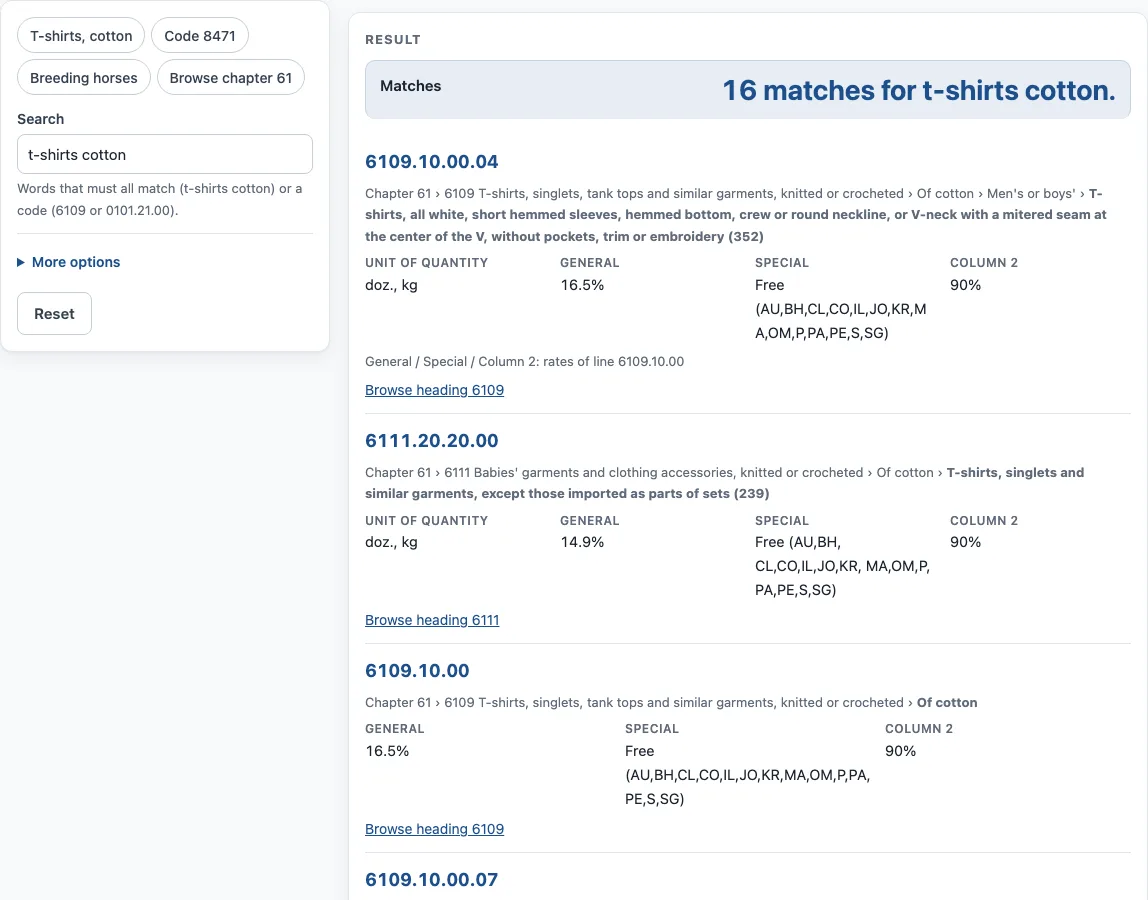
- Read the Matches line for the count, then check each row: the formatted HTS number, the full description path from chapter to line, the unit of quantity, and the General, Special and Column 2 rates. Use Browse heading on a row to see everything under that heading, and Show 50 more when the list is longer.
- Open How it was calculated to see each step with your own values.
To try the tool, use the example buttons: T-shirts, cotton; Code 8471; Breeding horses; and Browse chapter 61.
Under the result, Copy result copies the answer. Copy link saves all your inputs in the page address, so opening the link restores the same result. Print / save as PDF prints your inputs, the result, the calculation steps and the date.
What is an HTS code and how is it built?
An HTS number is the classification number that the US uses for imported goods. It can have up to 10 digits, written like 6109.10.00.04. The first 2 digits are the chapter (61), the first 4 the heading (6109) and the first 6 the subheading (6109.10). Those 6 digits are the international Harmonized System level, shared by every country that uses the HS.
Digits 7 and 8 make the US tariff rate line (6109.10.00), where the duty rate is set, and the last 2 digits are a statistical suffix used to count imports (6109.10.00.04).
How do you decide which HTS line a product belongs to?
Classification follows the General Rules of Interpretation (GRI). The first step is the wording of the headings and any section or chapter notes. If that does not settle the question, the more specific description applies, and then the essential character of the product decides it.
The search helps you find candidate lines. It does not choose the right one for you.
What do the General, Special and Column 2 duty columns mean?
The General column shows the normal trade relations rate, which applies to most countries. The Special column shows lower rates under trade programmes and free trade agreements, marked with programme codes such as A (Generalized System of Preferences), AU (Australia), KR (Korea) and S (USMCA). The Column 2 column applies to countries without normal trade relations. As of the 2026 HTS (Revision 21, checked 11 October 2026), General Note 3(b) lists four: Belarus, Cuba, North Korea and Russia; Belarus and Russia were added in 2022.
Why does a 10-digit line sometimes show a rate from its parent?
Some 10-digit statistical lines have no rate of their own. The rate is set on the 8-digit parent line. When this happens, the tool shows the parent’s rate and says so.
Do additional duties appear in the General rate?
No. Additional duties under Chapter 99 are listed separately in that chapter. Section 301 duties on goods from China and Section 232 duties are examples. These measures change often, so check Chapter 99 of the current schedule on hts.usitc.gov when you need the full duty picture.
Who is responsible for getting a classification right?
The importer is responsible for classifying goods correctly. If you need a binding answer, you can ask US Customs and Border Protection for a ruling. The CROSS database lists past rulings, which can show how similar goods were classified before.
How does a Schedule B number differ from an HTS number?
A Schedule B number is the export counterpart, maintained by the Census Bureau. US exporters can often use the 10-digit HTS number on export filings instead. Check which number your filing requires before you submit it.
Sources
- USITC Harmonized Tariff Schedule — export downloaded 11 October 2026 (2026 Revision 21), public domain.
- HTS General Notes (2026 Revision 21) — General Rules of Interpretation, Column 2 countries (General Note 3(b)) and special program codes (General Note 3(c)).
- CBP CROSS rulings — past classification rulings.
Frequently asked questions
Where does the data come from, and how current is it?
The data is the USITC export of the Harmonized Tariff Schedule, downloaded on 2026-10-11, when the current release was the 2026 HTS Revision 21. The USITC publishes new revisions during the year, so check hts.usitc.gov if you need a newer version. Program codes and the Column 2 countries are from the HTS General Notes (2026 Revision 21).
Is anything I type sent to a server?
No. The tool runs in your browser, and nothing you type is uploaded.
Can I use the results in commercial work?
Yes. You can use the results on products, packaging and documents with no attribution required.
What should I do if my search returns no matches?
Try the plain name of the material and the product, such as “cotton t-shirts”. You can also type the first digits of a code in Code prefix mode, or choose a chapter to narrow the search.
Can I browse every line in one chapter?
Yes. Enter a two-digit chapter number from 01 to 99 in Chapter (optional) and leave Search empty. Chapter 61 is one example.
Is the lookup free, and do I need an account?
The lookup is free, and you do not need to sign up.
Does the HTS lookup show the duty I will actually pay?
It shows the rates in the schedule. The duty you pay also depends on the country of origin, any free trade agreement you claim (the Special column), Chapter 99 additional duties, and fees such as the merchandise processing fee (19 CFR 24.23, which sets the current rate and limits). A customs broker can confirm the total for a shipment.
What does “Free” mean in the General column?
It means the normal duty rate for that line is zero. Other charges, such as Chapter 99 duties or fees, can still apply.
Related tools
- HS tariff code lookup — find the international 6-digit HS code for a commercial invoice.
- Schedule B lookup — find the 10-digit US export code for an AES filing.
- ISO country codes — 2-letter, 3-letter and numeric country codes for documents and data.
- UNLOCODE lookup — find the code of a port, airport or terminal for a booking or bill of lading.
- Container check digit calculator — check the ISO 6346 check digit of a shipping container number.
- GS1 barcode generator — GS1-128 labels with Application Identifiers, EAN-13 and ITF-14 carton codes.