HS Tariff Code Lookup (6-Digit HS Code Finder)
Search a product to find its international 6-digit HS code, the heading it belongs to and the national lines under it.
How to use the HS Code Lookup
- In the Search field, type the words that must all match, such as
cotton t-shirts, or a code such as61,6109or610910. - Open Search as and choose one of the options:
- Automatic (digits = code) treats digits, dots and spaces as a code and anything else as words.
- Words searches the text of the product descriptions.
- Code prefix matches codes that start with what you typed.
- Optionally, enter a two-digit chapter from 01 to 99 in Chapter. Leave the search empty to browse a whole chapter.
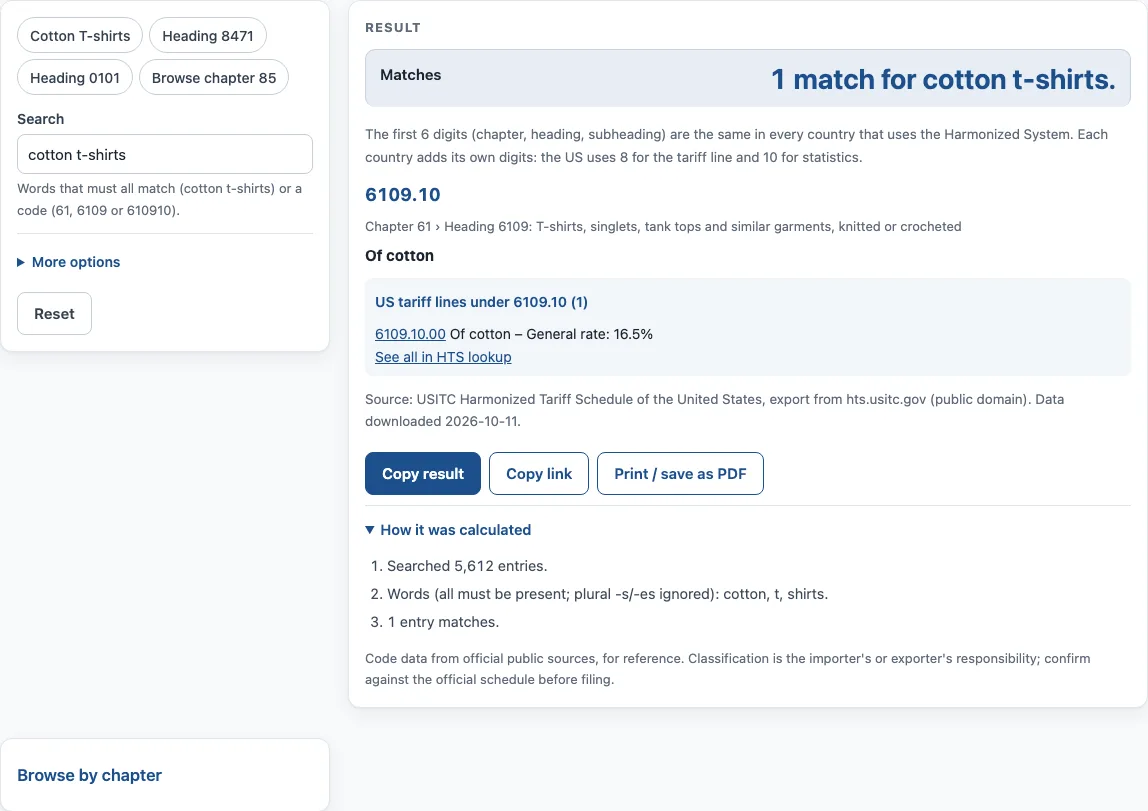
- Read the Matches line to see how many entries were found, then the list: each HS subheading shows its chapter and heading, its description and the US 8- or 10-digit lines under it, with a link that opens the line in the HTS code lookup.
- Open How it was calculated to see each step with your own values.
The example buttons Cotton T-shirts, Heading 8471, Heading 0101 and Browse chapter 85 fill in the fields for you, so you can see how a search works before using your own.
Under the result, Copy result copies the result text, and Copy link copies a page address that keeps all your inputs, so opening it restores the same result. Print / save as PDF prints the inputs, the result, the calculation steps and the date.
What is an HS tariff code?
An HS tariff code is a number that identifies a product for customs and trade purposes. The Harmonized System assigns each kind of product a code so that customs officials and traders in different countries refer to the same goods in the same way. The code is based on what the product is and what it is made of, not on its brand or price.
How is an HS code structured?
The first 6 digits of an HS code are the same in every country that uses the system. The first two digits are the chapter, and there are 97 chapters numbered 1 to 97; chapter 77 is reserved and not used. The next two digits form the heading, and the last two form the subheading. Reading the code from left to right takes you from a broad group of goods to a narrow one, so 61 is the chapter for knitted or crocheted apparel, 6109 is the heading for T-shirts, and 610910 is the subheading for cotton T-shirts.
Why do some countries’ codes have more digits?
Each country adds digits after the 6-digit level to fit its own tariffs and statistics. The United States uses 8-digit tariff lines and 10-digit statistical numbers, the EU uses 8-digit CN codes and 10-digit TARIC codes, and China and Canada use 10 digits. A code that stops at 6 digits is therefore a shared starting point rather than the complete national code.
Which HS code goes on a commercial invoice?
Shipping documents and customs declarations ask for the HS code. On a commercial invoice, the 6-digit code is usually enough when you do not know the destination’s full code. The importer then declares the full national code in the destination country.
Why can similar products have different codes?
The HS groups goods mainly by material and construction, so products that look alike can fall in different chapters. For example, a cotton shirt and a synthetic shirt are classified differently. To find the right code, search by the material and product, then read the heading and the chapter notes before you choose.
Why does an HS code stop working?
The World Customs Organization revises the HS in review cycles, which produced the 2017 and 2022 editions. The current edition is HS 2022; the next, HS 2028, enters into force on 1 January 2028 (per the WCO, checked October 2026). When a revision changes a heading, an older code may no longer exist in the current edition. If you find a code in an old document, check it against the current edition before you use it.
Sources
- USITC Harmonized Tariff Schedule (2026 Revision 21, downloaded 11 October 2026) — 6-digit descriptions, public domain.
- WCO: What is the Harmonized System and HS 2028 amendments (checked October 2026).
Frequently asked questions
Is the HS code lookup free to use?
Yes. The tool is free and does not require a sign-up.
Is anything I type uploaded?
No. The tool runs in your browser, and nothing you type is uploaded.
What is the difference between a harmonized code and an HS code?
They are the same kind of number. Courier forms from FedEx, UPS and DHL may ask for a “harmonized code”, “commodity code” or “tariff code”, and each of these means the HS-based number.
Can I use the results on products, packaging or documents?
Yes. Results may be used in commercial work, including on products, packaging and documents, with no attribution required.
Do I need the full 10-digit code?
Not always. For a commercial invoice, the 6-digit code is usually enough when the full destination code is unknown. The importer must declare the full national code, so check it with the destination country’s requirements.
Why is my search showing no matches?
Try fewer words, or switch Search as to a different option. You can also clear the search and enter a chapter to browse its entries.
Are the product descriptions official WCO text?
No. The descriptions on this page come from the US Harmonized Tariff Schedule, which is in the public domain and follows the HS structure at the 6-digit level. The official WCO text is not reproduced here.
Related tools
- HTS code lookup — find the US import classification number and its duty rates.
- Schedule B lookup — find the 10-digit US export code for an AES filing.
- ISO country codes — 2-letter, 3-letter and numeric country codes for documents and data.
- UNLOCODE lookup — find the code of a port, airport or terminal for a booking or bill of lading.
- Container check digit calculator — check the ISO 6346 check digit of a shipping container number.
- Barcode generator — Code 128, Code 39, EAN, UPC, ITF-14, Codabar and GS1-128, single or a sheet of labels.